One of the most common — and most costly — mistakes small business owners make is misclassifying a worker as an independent contractor (1099) when the IRS would consider them an employee (W-2). Get it wrong, and you could face back taxes, penalties, and interest, sometimes going back years. This guide breaks down exactly how the IRS decides who's an employee and who's a contractor, so you can classify your workers correctly the first time.
W-2 vs. 1099: What's the Actual Difference?
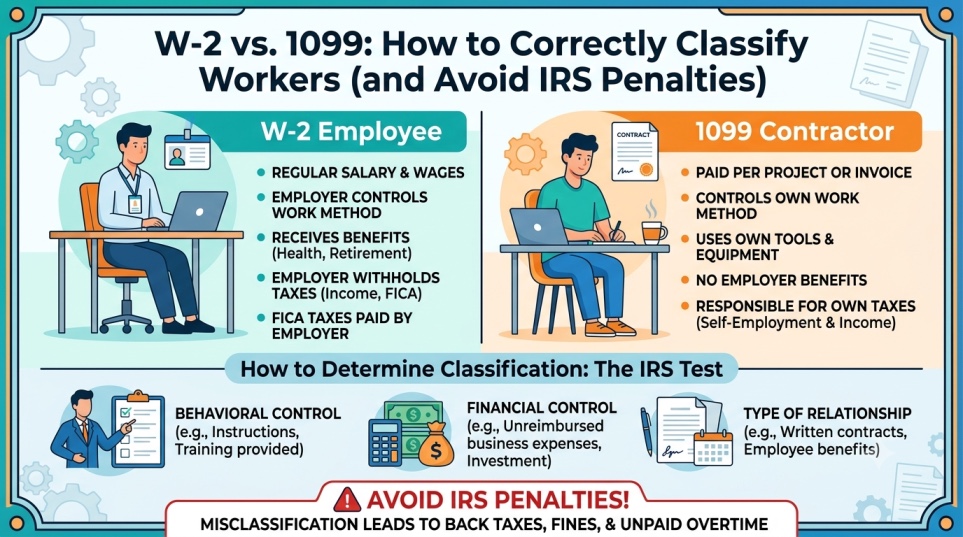
- W-2 employee: You control how, when, and where they work. You withhold income tax, Social Security, and Medicare from their pay, and you're responsible for the employer's share of payroll taxes.
- 1099 independent contractor: They control how the work gets done. You pay them a flat rate or project fee, and they're responsible for their own self-employment taxes.
The distinction isn't about what you call someone or what's written in a contract — the IRS looks at the actual working relationship.
The IRS's 3-Factor Test for Worker Classification
The IRS evaluates three main categories of control to determine worker status:
- Behavioral control: Do you direct how the worker does their job — set hours, provide training, dictate methods? More control usually means employee status.
- Financial control: Does the worker have unreimbursed expenses, use their own equipment, and have the ability to work for other clients? More independence usually means contractor status.
- Relationship type: Is there a written contract, employee benefits, or an expectation the relationship continues indefinitely? Ongoing, benefit-eligible relationships lean toward employee status.
No single factor decides the outcome — the IRS weighs the entire relationship. When in doubt, most compliance experts recommend treating a worker as a W-2 employee rather than risk misclassification.
What Happens If You Misclassify a Worker?
If the IRS or your state labor department determines a worker was misclassified, you may owe:
- Back payroll taxes (Social Security, Medicare, and unemployment tax) for the misclassification period
- Penalties and interest on unpaid taxes
- Potential back pay for overtime or benefits the worker should have received as an employee
- State-level fines, which vary and can be significant in states with aggressive enforcement
These costs can add up quickly, especially if the misclassification spans multiple workers or several years.
Common Misclassification Mistakes Small Businesses Make
- Paying someone as a 1099 contractor while requiring set hours and close supervision
- Classifying long-term, ongoing roles as "contract work" to avoid payroll taxes
- Assuming a signed contractor agreement protects you from IRS reclassification
- Not filing Form 1099-NEC for contractors paid over $600 in a year
How to Protect Your Business
The safest approach is to review each worker relationship individually against the IRS's behavioral, financial, and relationship factors — not to make blanket decisions across your whole team. If you're unsure about even one worker's classification, it's worth getting a professional review before it becomes a bigger issue.
At SmartSoft Solutions, we help small businesses across the USA correctly classify workers, set up compliant payroll systems, and stay ahead of IRS and state labor requirements. Not sure if your current setup is compliant? Request a free payroll compliance review and we'll walk through your worker classifications with you — no obligation.
Need expert financial help?
Talk to our CPA-supervised team today — free consultation.
Frequently Asked Questions
What's the main difference between a W-2 employee and a 1099 contractor?+−
A W-2 employee works under your direction and control, and you withhold and pay payroll taxes on their behalf. A 1099 contractor controls how their own work gets done and is responsible for their own self-employment taxes.
How does the IRS decide if a worker is an employee or contractor?+−
The IRS looks at three factors: behavioral control (who directs the work), financial control (who bears the business expenses and risk), and the type of relationship (contract terms, benefits, and expected duration).
What happens if I misclassify an employee as a 1099 contractor?+−
You may owe back payroll taxes, penalties, and interest, and potentially back pay for benefits or overtime the worker should have received. State labor departments may impose additional fines.
Can a signed independent contractor agreement protect me from misclassification claims?+−
Not on its own. The IRS and state agencies look at the actual working relationship, not just the paperwork. A contract alone won't override how the work is actually performed and controlled.
Do I need to file anything if I pay a 1099 contractor?+−
Yes. If you pay an independent contractor $600 or more in a calendar year, you're generally required to file Form 1099-NEC with the IRS and provide a copy to the contractor.